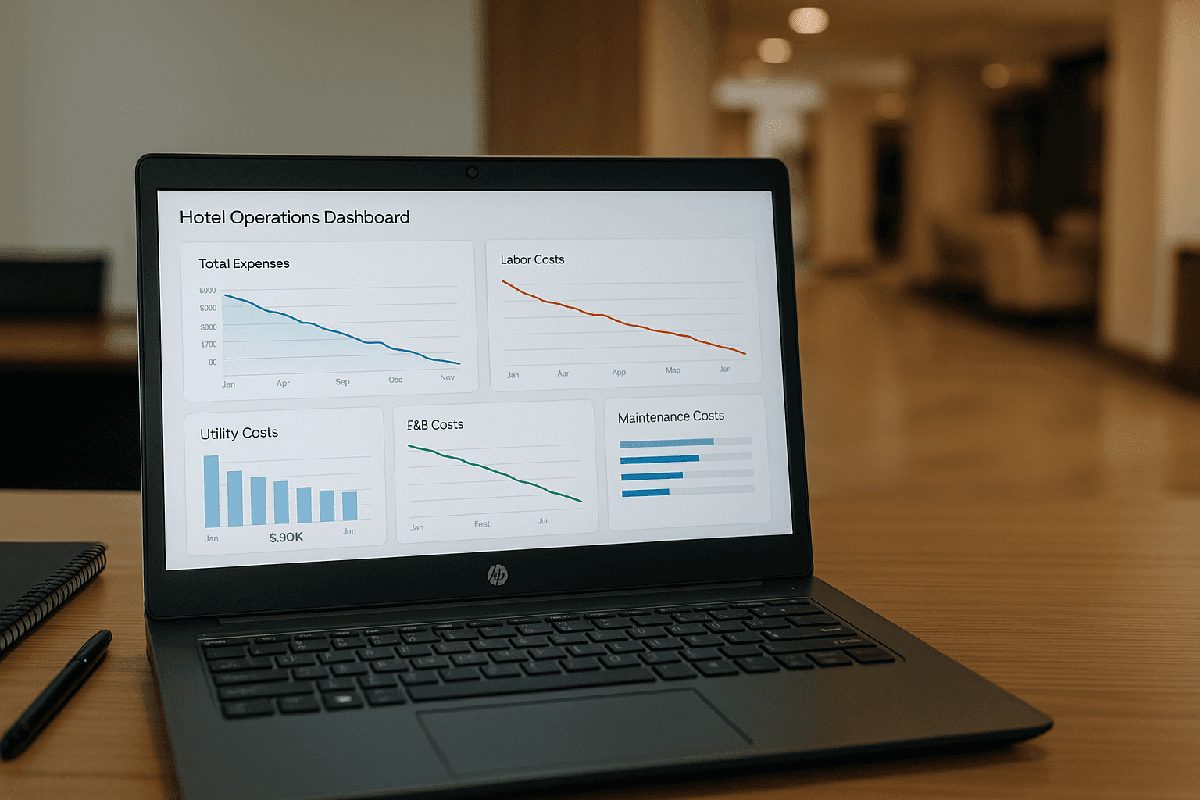
How AI Can Cut Hotel Expenses by 20% Without Hurting Service
Most hotels don't have a cost problem - they have a precision problem.
You're not overspending because you don't care. You're overspending because:
- Schedules are built on gut feel, not demand signals
- Lights, HVAC, and equipment run on fixed time blocks, not real occupancy
- F&B ordering is based on last weekend's numbers, not this weekend's actual pick-up
- Maintenance is reactive: things break, then you scramble
AI doesn't magically make expenses disappear. It makes them match reality more precisely - day by day, shift by shift.
A well-implemented AI stack can realistically reduce controllable expenses by ~20% across:
- Labor
- Utilities & energy
- F&B waste
- Maintenance & repairs
- Procurement & inventory
Without:
- Cutting service
- Downgrading product
- Burning out staff
The key is to stop thinking "where can we cut?" and start thinking "where are we flying blind?"
2. Where the 20% Comes From (Roughly)
Every hotel is different, but a typical target mix might look like:
- Labor: 5–8% reduction through smarter scheduling and task routing
- Utilities & Energy: 3–5% via smart energy management
- F&B Waste: 3–6% from better demand forecasting and prep planning
- Maintenance & Repairs: 2–4% from predictive maintenance and fewer emergency fixes
- Procurement & Inventory: 2–3% from smarter ordering and vendor optimization
These are not "slash and burn" numbers. They're the result of better timing and better decisions.
3. Labor: Forecasting and Scheduling That Matches Reality
Labor is usually your largest controllable expense - and the one most often managed by instinct.
3.1 AI-Powered Labor Forecasting
Traditional staffing:
- "We were busy last year around this date."
- "Let's add a second bartender just in case."
- "Fridays are usually heavy, so schedule more housekeepers."
AI forecasting can instead:
- Use historical occupancy, channel mix, group blocks, events, and booking pace
- Layer in local events, weather patterns, and flight schedules
- Predict front desk check-in spikes, housekeeping load by room type, outlet covers, etc.
- Provide shift-level forecasts instead of just a daily "busy vs. slow" guess
You move from:
"I think we'll be busy this weekend" to "We're forecasting a 22% spike in arrivals between 3–7 PM on Saturday. Add one more front desk host, reduce late-night staffing by one FTE." - AI-powered scheduling precision
3.2 Smart Scheduling and Task Routing
AI-connected scheduling tools can:
- Suggest optimal shift patterns based on forecasted demand
- Highlight overtime risks in advance
- Balance fairness (employee preferences, max hours, time-off requests) with coverage needs
- Auto-generate schedule drafts for managers to edit - not create from scratch
On top of that, task-routing logic can:
- Assign housekeeping rooms based on proximity and load
- Re-route small tasks to the nearest available team member
- Prevent multiple people from tackling the same request
Result: Less overtime, fewer idle hours, fewer "panic hires" - without cutting service.
Where does your property actually stand? The AI Readiness Score takes two minutes, asks no one for a call, and emails you a report sized to your rooms and ADR.
Get Your Score4. Smart Energy Management: Lower Bills, Same Comfort
Energy is often treated as fixed: "That's just our utility bill."
It's not.
4.1 Dynamic HVAC and Lighting
With the right sensors and AI layer, you can:
- Adjust HVAC based on:
- Actual occupancy (not just theoretical)
- Check-in/check-out patterns
- Weather and time-of-day
- Dim or shut lights in low-traffic zones automatically
- Pre-condition rooms just before arrival, not all afternoon
Example behaviors:
- Rooms in "dirty" or "OOO" status held at an efficient setpoint
- Public spaces warmed/cooled based on event schedules and live foot traffic
- Back-of-house areas (offices, corridors, storage) on smarter schedules
4.2 Benchmarking and Anomaly Detection
AI can also:
- Compare your building's performance against your own historical baseline
- Flag unusual spikes in consumption (e.g., a stuck valve, leaky window, or equipment failure)
- Suggest setpoint tweaks for specific zones and times
You're not constantly tweaking thermostats. You're approving intelligent, data-driven behavior.
5. F&B: Demand Forecasting and Waste Reduction
Kitchens are full of tiny, expensive decisions that rarely get proper data.
5.1 Forecasting Covers, Items, and Dayparts
AI can analyze:
- Historical covers by day, time, season
- Booking patterns and group profiles
- Weather (patio usage, pool bars, ice cream, hot drinks)
- Holidays, events, flight arrivals, and local calendars
And then predict:
- Expected covers by hour
- Likely product mix by outlet
- Special spikes (group dinners, weddings, conferences)
5.2 Smarter Prep and Ordering
With better forecasts, you can:
- Prep closer to actual demand
- Order perishable items more precisely
- Adjust specials and menu engineering to shift demand toward inventory you already have
- Reduce emergency orders (often more expensive and less efficient)
5.3 Waste and Yield Analytics
AI can also:
- Analyze POS data + inventory usage
- Flag high-waste dishes or ingredients
- Suggest portion adjustments or menu tweaks
- Highlight items that are consistently over-prepped or under-ordered
Result: Lower food cost, less waste - and a menu that more closely matches what guests actually want.
6. Predictive Maintenance: Fix It Before It Breaks
Break/fix is expensive:
- Emergency call-outs
- Room downtime
- Guest recovery costs
- Staff distraction and overtime
6.1 From Reactive to Predictive
With data feeds from:
- BMS (Building Management Systems)
- Elevators, boilers, chillers, HVAC units
- Smart sensors (temperature, vibration, flow, humidity)
AI can:
- Learn what "normal" looks like for your assets
- Detect early signs of failure (e.g., unusual vibration or energy draw)
- Alert engineering before a unit fails
- Suggest optimal time windows for service based on occupancy patterns
6.2 Smarter Preventive Schedules
Instead of:
- "Service every X months whether it needs it or not"
You move to:
- "Service when usage, performance, or anomalies indicate it's the right time."
This reduces:
- Over-maintenance (wasted labor and parts)
- Under-maintenance (crises and downtime)
7. Procurement & Inventory: Buying What You Actually Use
Procurement is full of invisible leakages:
- Overstocked items that sit in storage
- Understocked essentials that require rush deliveries
- Multiple vendors for the same product at different prices
- Promotions/discounts not being used effectively
7.1 AI for Spend Analysis
AI can ingest:
- Invoices
- POs
- Inventory movements
- Vendor catalogs
And then:
- Group spend by category, product, and vendor
- Highlight price discrepancies for equivalent items
- Identify over-reliance on high-cost SKUs
- Suggest consolidation opportunities for better volume discounts
7.2 Smarter Reorder Points
Instead of fixed "min/max" levels, AI can:
- Set dynamic reorder points based on seasonality and usage trends
- Factor in lead times
- Prevent both stockouts and overstock scenarios
You're not guessing when to order. You're responding to reality.
8. Prioritizing Quick-Win AI Projects (No Renovation Required)
You don't need a full-stack transformation on day one. You need one or two domains where:
- Data is already available
- Impact is clear
- Change management is manageable
Tier 1: 90-Day Quick Wins
These typically have the fastest ROI and minimal physical disruption:
- Labor Forecasting & Scheduling
- Input: PMS + POS + events + historical data
- Output: Better schedules, less overtime, reduced idle labor
- F&B Demand Forecasting
- Input: POS history, banquet events, seasonality
- Output: Less waste, more precise ordering
- Basic Energy Optimization via Setpoint & Schedule Rules
- Input: Occupancy + simple building controls
- Output: Lower energy bills without touching guest comfort
Tier 2: 6–12 Month Unlocks
- Predictive Maintenance for Key Assets
- Focus on high-cost, high-impact equipment (boilers, chillers, elevators)
- Procurement Intelligence & Vendor Optimization
- Start with one or two large spend categories (e.g., F&B, linens, amenities)
- Deeper BMS Integration & Smart Controls
- Closer integration between PMS, BMS, and occupancy data
9. How to Start: A Simple 4-Step Plan
You don't need a huge AI strategy deck. You need a simple plan:
Step 1: Pick Two Cost Buckets
For example:
- Labor + F&B
- Labor + Energy
- F&B + Maintenance
Choose where the pain is highest and where data is easiest to access.
Step 2: Establish a Baseline
Document:
- Current total spend in each category
- Key drivers (e.g., overtime %, food waste %, kWh/sqft)
- Rough "cost per occupied room" where applicable
You need a starting line to prove the delta.
Step 3: Implement One AI Use Case Per Bucket
Examples:
- Labor: AI schedule recommendations for front desk + housekeeping
- F&B: AI forecast for weekend demand + adjusted prep plans
- Energy: Smarter setpoints and schedules for public spaces
Give it 60–90 days and track trends.
Step 4: Reinforce the Narrative With Staff
The goal is not "spend less at all costs." The goal is:
"Let's use data so nobody is exhausted, nothing is wasted, and guests still get great service." - Core messaging for staff communication
When teams understand that AI is helping them avoid chaos - not replacing them - you get adoption, not resistance.
10. The Bigger Picture: Efficiency as a Service Upgrade
Cutting costs is usually framed as the enemy of experience. With AI, the opposite can be true.
- Better scheduling = fewer burned-out employees and better interactions
- Less waste = fresher food and more relevant offerings
- Smarter energy use = more comfortable, consistent spaces
- Predictive maintenance = fewer breakdowns and guest disruptions
- Procurement intelligence = higher quality at the same or lower cost
You're not just spending less. You're spending smarter - in ways guests can feel.
Hotels that embrace this mindset will quietly unlock that 20% reduction in controllable expenses. And instead of feeling like austerity, it will feel like competence.
This article is part of HospitalityOS's ongoing research into how artificial intelligence is transforming the hospitality industry. Our research team analyzes real-world implementations, interviews hotel operators, and distills actionable insights for properties of all sizes.
For the complete analysis with implementation frameworks, ROI calculators, and case studies, download our 2026 Official Guide to Hotel AI - the industry's most comprehensive resource for hotel operators navigating AI adoption.
Sources & Further Reading
Get two full chapters of The 2026 Official Guide to Hotel AI
The AI Readiness Scorecard + the P&L Opportunity Heat Map - see exactly where your property stands and what each gap is worth.
Plus one tactical AI play each week. Unsubscribe anytime. Prefer to start interactive? Take the 2-minute AI Score.
Related Research
- Reduce Hotel Labor Costs with AI: Deploy Strategies, Not Just Technology →
- Hidden Hotel Costs Reduction with AI Automation: Find the $50-100K You're Leaving on the Table →
- AI F&B Operations in Hotel Restaurants: The Untapped Goldmine of 30-40% Margin Improvement →
- AI Housekeeping Operations Optimization: From Daily Schedules to Long-Term Staffing Strategies →
- Automating Hotel Operations: Do's and Don'ts →
- Measuring AI ROI in Hotels: The Metrics That Actually Matter →